Monitoring shows no immediate risk of major, imminent landslides or dangerous wave run-up in inhabited areas.
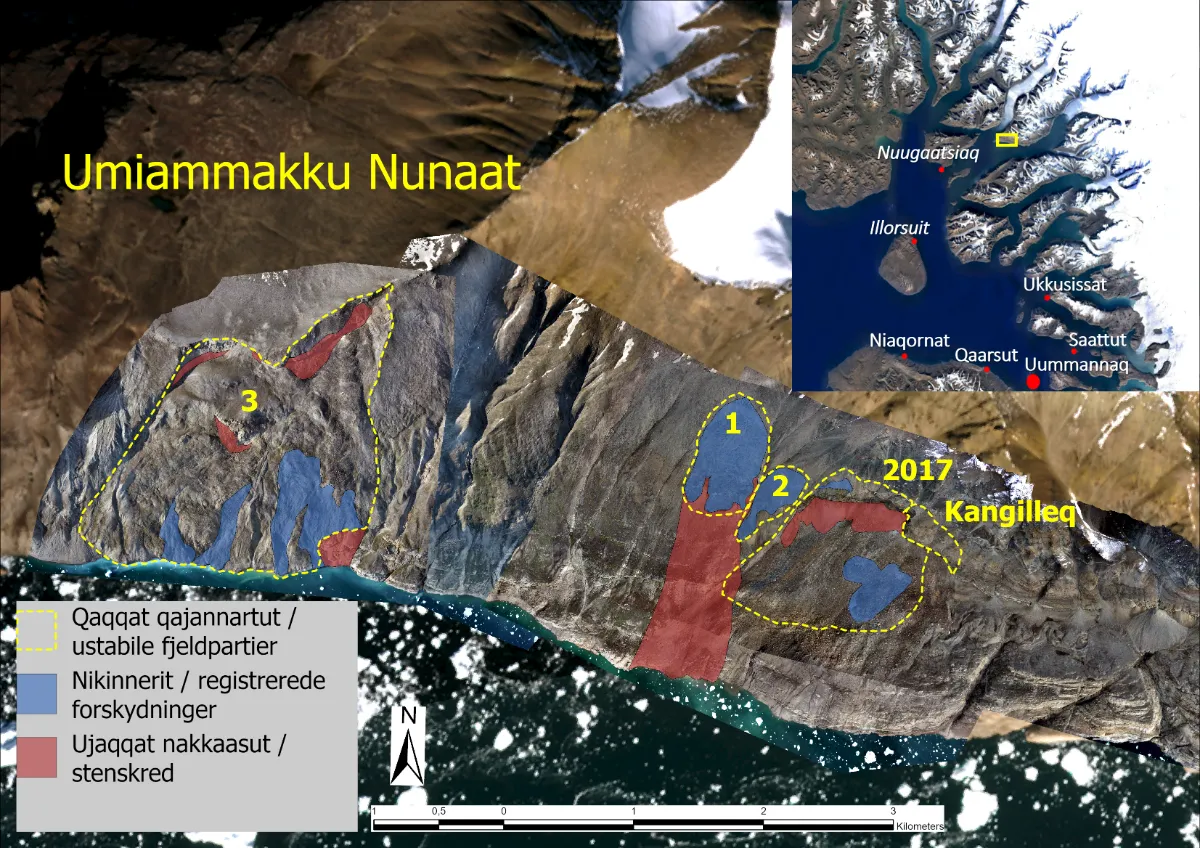
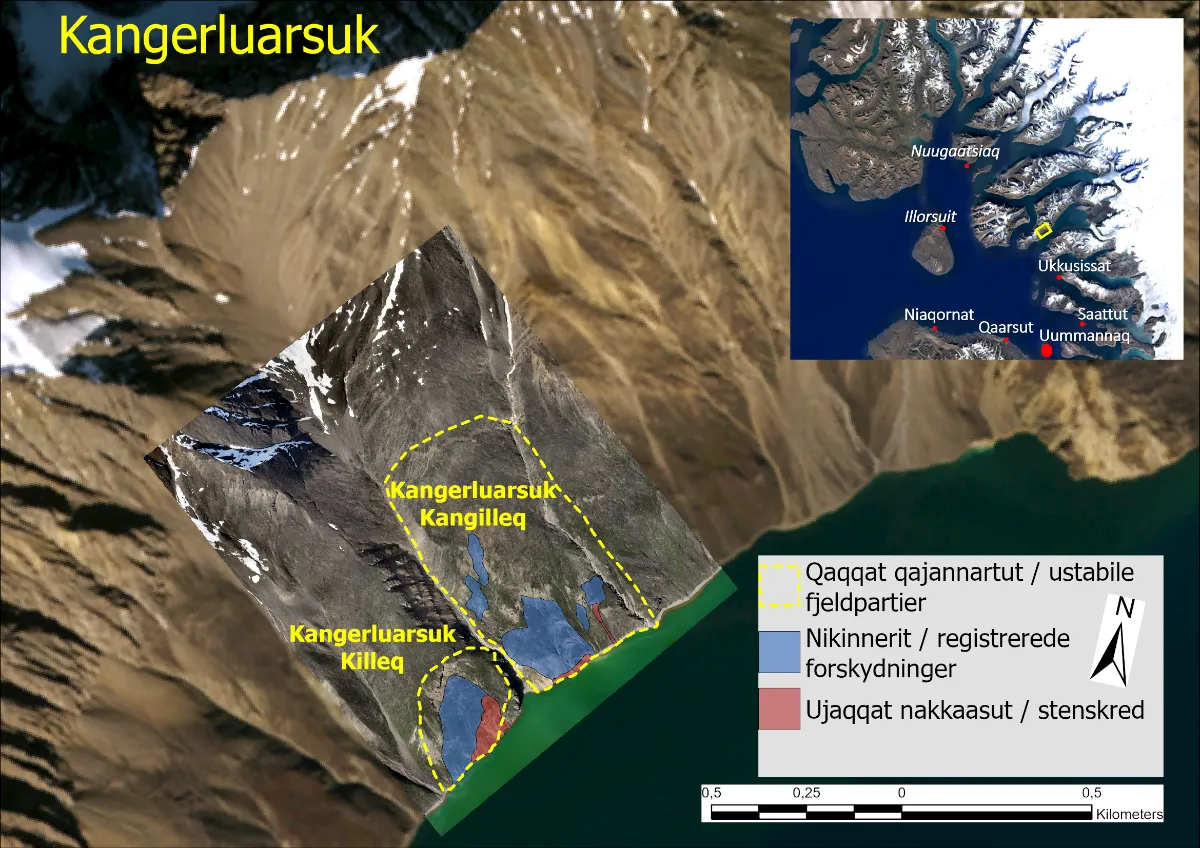
Spontaneous minor slides may occur on the mountain slopes marked in red in Figures 1 and 2. Staying near these red-marked areas is discouraged, both on land and at sea.
Summary of Monitoring Data for the Past Month
Umiammakku Nunaat:
Monitoring data continues to show activity in the monitored mountain sections at Umiammakku Nunaat.
Rockfalls and rockslides have been observed, as well as relatively slow, continuous movements in parts of the mountain slopes – in line with the activity observed in previous months (see Figure 1).
The weather station at Umiammakku Nunaat has recorded temperatures ranging between -13 °C and +10 °C. Days with temperatures above freezing have seen more frequent landslides compared to days with below zero degrees. Movements in the mountain slopes are expected to increase through summer.
Kangerluarsuk:
The GPS stations at “Kangerluarsuk Kangilleq” show a slight acceleration in movements recorded over the past month, consistent with observations from previous years during the transition from spring to summer.
In the near-coastal part of the slope at “Kangerluarsuk Killeq”, constant displacements and frequent rockfalls continue to be recorded (See Figure 2). It cannot be ruled out that a larger mass movement may slide into the fjord from the area. However, such an event is not considered to pose a risk to inhabited areas but could potentially cause local wave run-up in the Kangerluarsuk area.
Registered rockfall events and displacements in the monitored slopes are shown as coloured areas on the maps in Figures 1 and 2 below. Blue areas indicate persistent sliding movement, while red areas mark locations with repeated rockfall events within the past month.
The next situation assessment will be published on Wednesday, 2 July 2025. A notice will be issued earlier in case of critical events in the monitored areas.